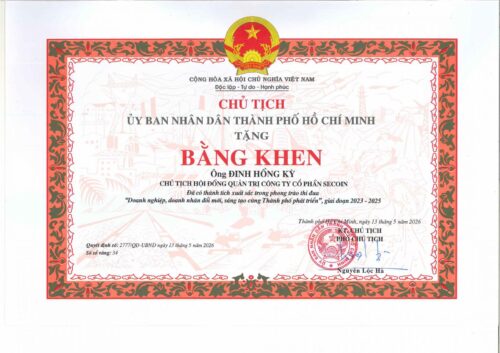
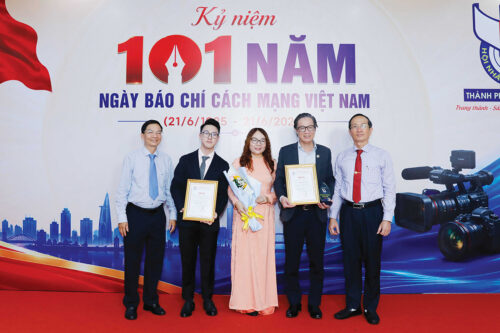
Cement tiles – once a nostalgic part of childhood for a generation of Vietnamese and thought to be long forgotten – have now become a “luxury brand” exported to 45 countries. Mr. Dinh Hong Ky and his wife, Mrs. Vo Lien Huong, call them “hand-embroidered tiles.”
Published in Saigon Times on December 25, 2014.


(TBKTSG) – Cement tiles — once associated with the simple childhood of a generation of Vietnamese and thought to have been forgotten — have now become a “premium brand” exported to 45 countries. Mr. Dinh Hong Ky and Mrs. Vo Lirn Huong refer to them as “hand-embroidered tiles.”
Each Tile Is a Work of Art
Cement tiles are unbaked, handcrafted tiles. As a result, even with the same pattern, each tile bears its own unique character, deeply influenced by the artisan’s individual “handwriting.”
Introduced to Vietnam by the French in the 19th century, cement tiles gradually became a widely used product throughout the country. These tiles are known for keeping interiors cool in the summer and warm in the winter. During the subsidy era, many office buildings and hotels were paved with cement tiles. In most architectural works built by the French in Vietnam, cement tiles appear as a distinctive hallmark.
However, by the 1990s, fired bricks and ceramic tiles began to take over, and cement tiles nearly disappeared. Their quality declined, and they were reduced to a low-cost product, mainly used by the poor. Most cement tile artisans were forced to abandon their craft and live in hardship.
Meanwhile, in Europe, the United States, and the Middle East, cement tiles are considered luxury items due to their handmade nature — something only the wealthy could afford. In the Netherlands, France, or Germany, where labor costs are high, cement tiles are sold at around 100 euros per square meter, while in Vietnam, they cost only about 2 euros per square meter. Mr. Kỳ repeatedly asked himself: why, with such skilled cement tile artisans, does Vietnam not export to these markets? That’s when the dream of creating a Vietnamese premium cement tile brand began to take shape.
Mr. Ky traveled across Ho Chi Minh City and nearby provinces to track down former artisans who once designed tiles for factories like Thanh Danh, Duc Tan, and Doi Tan. He asked these artisans to help him find others, gathered them together, provided them with good working conditions, and promised to ensure a stable livelihood for them.
In 2009, Secoin took over the Thanh Danh decorative tile factory—one of Vietnam’s oldest cement tile manufacturers, originally established in 1910. Most of the former Thanh Danh artisans returned to work at their old factory, now operating under the Secoin cement tile brand.
Currently, Secoin operates two cement tile factories. About 95% of its tile production is consistently exported to 45 countries, serving around 800 customers worldwide.
Secoin’s average annual revenue is nearly VND 200 billion (with 70% coming from cement tiles), growing steadily by 20–25% each year. Its profits have not seen dramatic spikes but have increased steadily and reliably over time.
Currently, Secoin’s cement tile factory, owned by Mr. Ky, employs over 200 artisans, including some who are over 60 years old with nearly 45 years of experience—among the first and oldest cement tile craftsmen in Vietnam. Mrs. Lien Huong said, “Their income is now much higher than before, ranging from 7 to 15 million VND per month, not including the 13th and 14th month bonuses and other benefits. They are very loyal to the company…”
But things have not always been smooth. Secoin’s first cement tile factory was built in 2007 in Bình Dương province with a strategy focused on export, yet nearly 90% of the output was initially defective. By the second year, this rate dropped to 60%. Mr. Kỳ instructed the artisans to reduce their daily output from 200 tiles to just 90 tiles, but each tile had to be made carefully and beautifully.
Alongside improving craftsmanship, Mr. and Mrs. Kỳ researched foreign production technologies and at a trade fair in Germany, Mr. Kỳ found a chemical that elevated the quality of Secoin’s tiles to a new level. This “magic liquid” mixed into the colors made the painted patterns absorb into the tiles smoothly, sharply, and most importantly, without smudging. From then on, Secoin’s tiles gained a fresh appearance. Today, the defect rate has dropped to only 1.6%. For tiles with complex patterns, workers produce only 20 per day. “They’re like paintings, like artistic works with high creative value—not just tiles…” Mr. Kỳ said.
If ceramic tiles are like computer-embroidered fabric, then cement tiles are like hand embroidery. A ceramic tile factory with automated lines can produce 5,000 to 10,000 square meters of tiles per day, while a similarly sized cement tile factory produces only 200–300 square meters daily. Mr. Ky said cement tiles hold a small market share but have a unique position and great potential. Their profit margin is high.
Currently, Secoin’s cement tiles sell for about 600,000 VND per square meter, the highest price in Vietnam and nearly twice the price of other domestic cement tiles, but foreign orders keep the factory’s production schedule full all year.
The Most Precious Value Comes from the Hands
Secoin is not only famous for cement tiles; Mr. Ky is also known in the construction industry as the “king of outdoor tiles” because his company pioneers other non-fired building materials.
Mr. and Mrs. Kỳ introduced Italian non-fired tile technology to Vietnam and transferred it to over 20 local factories, naming the product Terrazzo tiles. These are the same tiles used around Hoan Kiem Lake. Currently, there are more than 150 factories of various sizes producing this type of tile nationwide.
Secoin also supplies equipment and technology transfer from abroad to 50 domestic companies producing non-fired building materials and introduced wet-press color tile technology to Vietnam. “Non-fired materials are more durable than fired ones and quite diverse. Producing environmentally friendly and recyclable products is our sustainable development criterion. In the long term, we will focus on our core business — various types of non-fired tiles — and strive to launch new products every year,” Mr. Ky said.
Having faced many challenging traps—such as numerous investors wanting to buy the company (which Mr. Kỳ refused), friends advising him to issue shares and become a billionaire overnight, losses from a terrazzo factory that forced them to switch to roofing tiles, and an unsuccessful investment in wood particleboard that had to be sold off—these experiences show that the current success of Mr. and Mrs. Kỳ’s business has come through many hardships.
The lesson Mr. Ky learned is to focus on the core business. “It’s really hard to compete globally with airplanes, cars, or computers. But once you build your own unique values, you can establish a global position. If I had distracted myself with share issuance or random real estate investments, I wouldn’t have Secoin today,” he shared.
Secoin today is a source of pride for the Kỳ family. While each Secoin worker may generate less revenue compared to many other companies, Mr. Kỳ believes the most precious value lies in creating products with one’s own hands rather than merely buying and reselling for profit. “I don’t aspire to grand goals. I just want to do well for my family and my workers. Not exploiting them or delaying their wages is already a big challenge…” Mr. Kỳ confided.
The Kỳ family owns about 70% of Secoin. Based on successful lessons from family businesses worldwide, Mrs. Lien Huong said they will maintain the family business model long-term. According to her, without term limits, family businesses have certain stability. In today’s economic context, this model is suitable and sustainable.