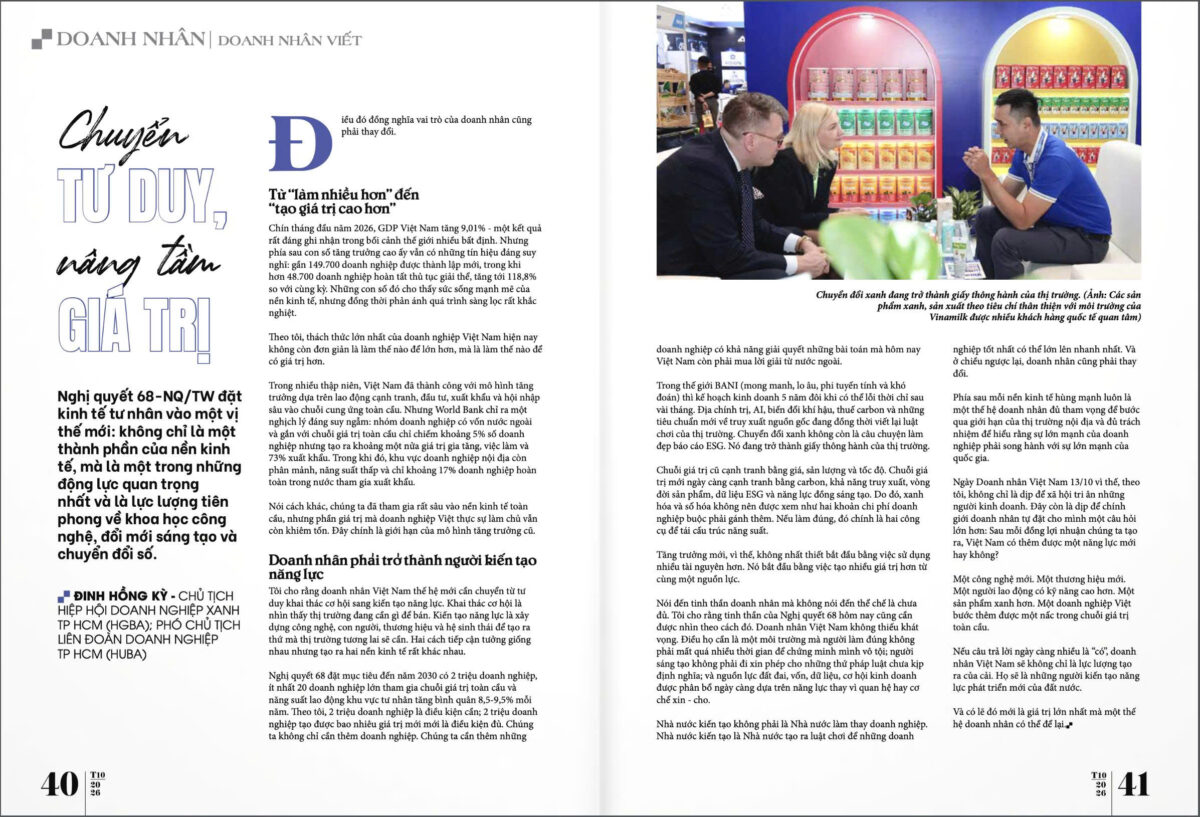
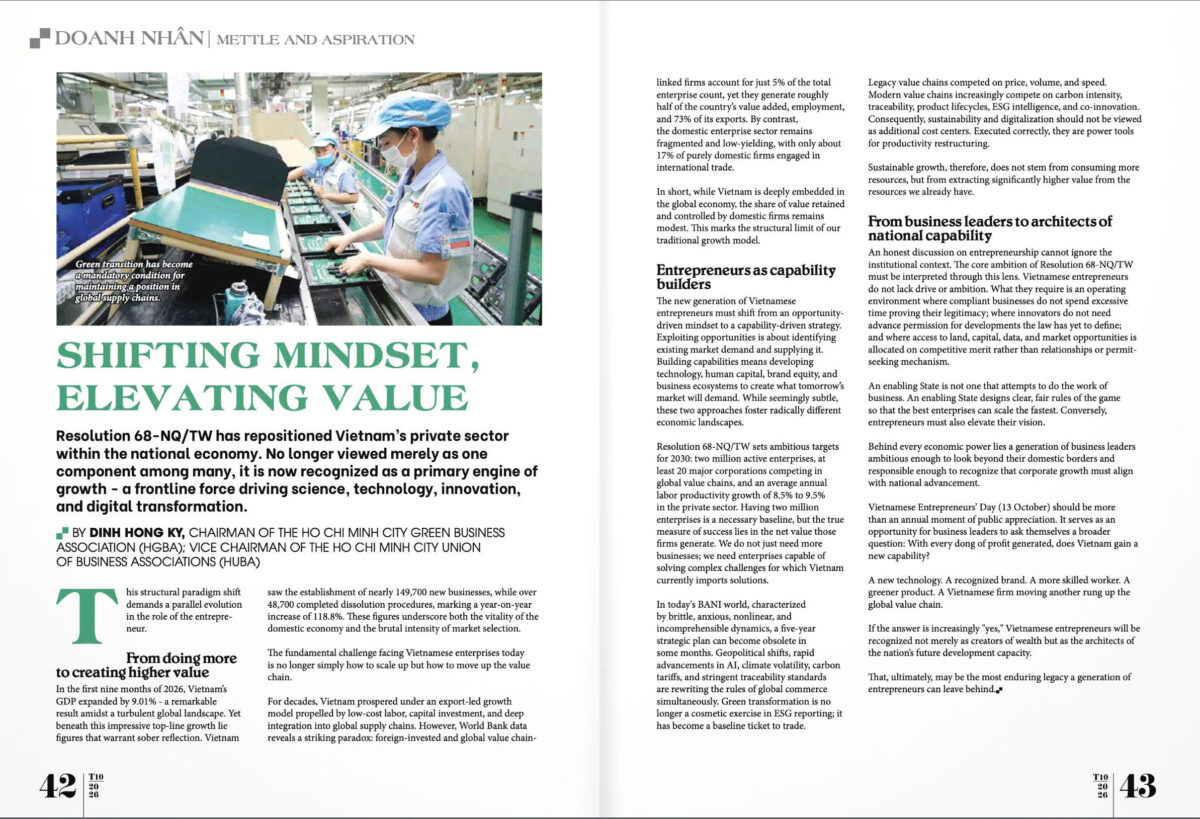
Article by Mr. Dinh Hong Ky published in Business Forum Magazine on October 30, 2026
Dinh Hong Ky – Chairman of the Ho Chi Minh City Green Business Association (HGBA); Vice Chairman of the Ho Chi Minh City Union of Business Associations (HUBA)
Resolution No. 68-NQ/TW places the private sector in a new position: not merely as a component of the economy, but as one of its most important driving forces and a pioneering force in science and technology, innovation, and digital transformation.

This also means that the role of entrepreneurs must change.
From “Doing More” to “Creating Greater Value”
In the first nine months of 2026, Vietnam’s GDP grew by 9.01% – a highly commendable achievement amid considerable global uncertainty. However, behind this impressive growth figure are signals that warrant reflection: nearly 149,700 new enterprises were established, while more than 48,700 enterprises completed dissolution procedures, an increase of 118.8% compared with the same period last year. These figures demonstrate the strong vitality of the economy while also reflecting an extremely rigorous process of market selection.
The greatest challenge facing Vietnamese enterprises today is no longer simply how to grow bigger, but how to create greater value.
For decades, Vietnam has succeeded with a growth model based on competitive labor costs, investment, exports, and deep integration into global supply chains. However, the World Bank points to a thought-provoking paradox: foreign-invested enterprises and those connected to global value chains account for only about 5% of all enterprises, yet generate approximately half of value added and employment, and 73% of exports. Meanwhile, the domestic business sector remains fragmented, with low productivity, and only around 17% of wholly domestic enterprises engage in exports.
In other words, we have become deeply integrated into the global economy, but the share of value that Vietnamese enterprises truly control remains modest. This is precisely the limitation of the old growth model.
Entrepreneurs Must Become Architects of Development Capabilities
I believe that the new generation of Vietnamese entrepreneurs needs to shift from a mindset of seizing opportunities to one of building capabilities.
Seizing opportunities means identifying what the market currently needs and selling it. Building capabilities means developing technology, people, brands, and ecosystems to create what the market will need in the future. These two approaches may appear similar, but they give rise to two very different economies.
Resolution 68 sets a target of having 2 million enterprises by 2030, with at least 20 large enterprises participating in global value chains and labor productivity in the private sector increasing by an average of 8.5–9.5% annually.
In my view, having 2 million enterprises is a necessary condition; how much new value those 2 million enterprises can create is the sufficient condition. We do not simply need more enterprises. We need more enterprises capable of solving problems for which Vietnam currently still has to purchase solutions from abroad.
In a BANI world (brittle, anxious, nonlinear, and incomprehensible), a five-year business plan can sometimes become obsolete in just a few months. Geopolitics, AI, climate change, carbon taxes, and new traceability standards are simultaneously rewriting the rules of the market. Green transformation is no longer about making ESG reports look better. It is becoming a passport to market access.
Traditional value chains compete on price, output, and speed. New value chains increasingly compete on carbon performance, traceability, product life cycles, ESG data, and co-creation capabilities. Therefore, greening and digitalization should not be viewed as two additional costs that enterprises are forced to bear. If implemented properly, they are two powerful tools for restructuring productivity.
New growth, therefore, does not necessarily begin with consuming more resources. It begins with creating greater value from the same resources.
Discussing the entrepreneurial spirit without addressing institutions is insufficient. I believe the spirit of Resolution 68 today should also be viewed from this perspective. Vietnamese entrepreneurs do not lack ambition.
What they need is an environment in which those who comply with the law do not have to spend excessive time proving their innocence; innovators do not have to seek permission for things that the law has not yet defined; and resources such as land, capital, data, and business opportunities are increasingly allocated based on capabilities rather than relationships or discretionary approval mechanisms.
An enabling state is not one that does the work of enterprises. An enabling state is one that establishes the rules of the game so that the best enterprises can grow the fastest. Conversely, entrepreneurs themselves must also change.
Behind every powerful economy is a generation of entrepreneurs ambitious enough to move beyond the limits of the domestic market and responsible enough to understand that the growth of their enterprises must go hand in hand with the development of their nation.
Vietnamese Entrepreneurs’ Day, therefore, in my view, is not merely an occasion for society to express gratitude to businesspeople. It is also an opportunity for entrepreneurs themselves to ask a more fundamental question: For every dong of profit we generate, does Vietnam gain a new capability?
A new technology. A new brand. A more highly skilled worker. A greener product. A Vietnamese enterprise moving one step higher in the global value chain.
If the answer is increasingly “yes,” Vietnamese entrepreneurs will not merely be a force that creates wealth. They will become the architects of the country’s new development capabilities.
And perhaps that is the greatest legacy a generation of entrepreneurs can leave behind.
Original article: https://diendandoanhnghiep.vn/chuyen-tu-duy-nang-tang-gia-tri-10186772.html