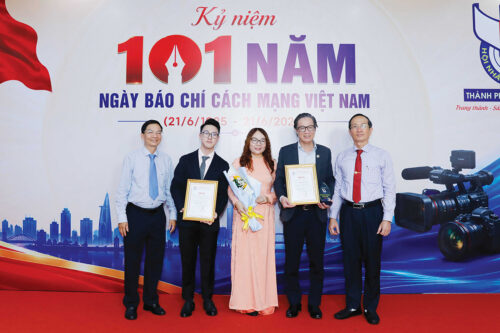
On November 30, 2021, Mr. Dinh Hong Ky – Chairman of the Board of Directors of Secoin Joint Stock Company shared about Secoin and the story of young people, startups, groups of entrepreneurs and businesses with Saigon Online Business Newspaper.
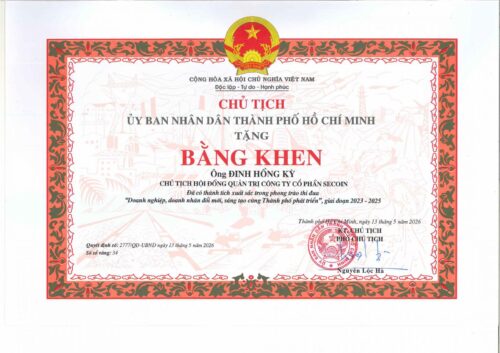
Holding the dual roles of Chairman of the Board of Directors of Secoin Joint Stock Company and Vice Chairman of the Vietnam Building Materials Association (VBM), as well as Standing Vice Chairman cum General Secretary of the Ho Chi Minh City Construction and Building Materials Association (SACA), Mr. Dinh Hong Ky has made significant contributions to entrepreneurs and businesses in the construction sector and the wider community.
Amidst the busy days adapting to the “new normal” for both businesses and association activities, Mr. Dinh Hong Ky still spared me two hours to share many insights about Secoin and matters concerning young people, startups, and entrepreneurial/business groups.
Aside from leading a major company, you also hold important positions in two business associations, so your schedule must be very busy…
-
Previously, I devoted 100% of my time to my own business activities, focusing on the “daily bread” of myself and Secoin’s staff and workers. However, in recent years, perhaps due to age, I’ve changed my perspective—I realized I could use my experience and existing relationships to participate in associations, not just as a member of the Ho Chi Minh City Business Association but also in industry-specific associations, hoping to contribute some wisdom and energy to the entrepreneurial community in general and entrepreneurs and businesses in the building materials sector in particular.
Moreover, after living and working abroad, I noticed that building an association is not as simple as many people think. Associations are often viewed as social clubs for sharing spirit and perhaps occasionally connecting business. But in developed countries, associations can evolve into guilds with significant roles and authority, having important voices with members and representing the industry in discussions with officials—from local to central government—to ensure legitimate business rights. Given Vietnam’s pursuit of a market economy, it is essential to develop practical and strong associations that can become guilds like those in developed countries.
SACA is managed by the Ho Chi Minh City Department of Construction but from the chairman to members are private and foreign enterprises. Being part of a long-established association with state backing, I and other entrepreneurs want to develop it toward becoming a guild, bringing real value to members and having an influential voice with the government and construction sector.
How do you balance your work between Secoin and the two associations?
-
My work at the company is very busy managing seven factories across three regions, working with supply chains and partners not only in Vietnam but also in more than 60 countries across five continents. However, thanks to 33 years of experience and the application of the most modern and optimized management systems, my role as a leader at Secoin is manageable. This allows me to dedicate a certain amount of time to other activities, especially association work and some social/community support.
For me, balancing time among many tasks lies in planning. I have collaborated with many Japanese colleagues and admire their working style. Before each task, they study thoroughly to prepare a detailed implementation roadmap. So when challenges or risks arise, they can proactively address them. I don’t multitask chaotically but arrange each job at a specific time with different priority levels.
Is this why you had a suitable plan for Secoin to “stand firm” through many complicated months of the Covid-19 pandemic?
-
Of Secoin’s seven factories, three are in Hanoi and two in Da Nang, which were basically not heavily affected by Covid-19. But for the two factories in Di An (Binh Duong) and Binh Chanh (Ho Chi Minh City), our workforce fluctuated significantly. After October 1, 2021, when production was allowed to resume, the factories were short of about 25-30% of staff. However, after one and a half months of recovery, workers became reassured by the company’s policies on salary, bonuses, and pandemic prevention safety, so we didn’t have many shortages.
In 2020, when the world was severely affected by Covid-19, Secoin’s supply chain was seriously impacted because our export markets were mainly the US and European countries. At that time, those countries were under social distancing measures and transportation costs doubled or tripled. Even chartering cargo ships was difficult, so our export volume dropped by 35%.
This year, as export markets began to recover, Vietnam faced a severe fourth wave of Covid-19. The “three onsite” production policy was only at a minimal level and couldn’t meet customer demand. However, since October, Secoin’s production and exports have been relatively smooth. The Binh Chanh factory has export orders booked until March 2022; the Binh Duong factory is fully booked until January 2022. Domestically, Secoin is a strategic partner of major real estate developers. The recovering property market means large demand for building materials, so our factories have to operate at full capacity to meet market needs.
Currently, the Vietnamese construction industry is developing rapidly with great potential in the global market. What should your company and the industry do to seize this opportunity?
-
Indeed, our construction and building materials industry is growing strongly. Companies in this sector have the capacity to export materials to many countries and build large projects abroad. In 2020, despite Covid-19 impacts, the total value of the building materials sector reached $22 billion, accounting for over 6.5% of the country’s GDP. However, achieving these results often came at the cost of heavy resource and mineral consumption and environmental neglect.
Given the global trend of environmental protection, the world increasingly demands green and recyclable products. To enter global markets, Vietnamese companies must change their mindset and traditional production methods. Because global markets not only care about product quality and price but also strictly check environmental protection, labor safety, employee insurance, wage scales… For the construction industry, the world market is buying not just products but the entire operational system of the company.
Therefore, to survive and develop, Vietnamese companies in general, and those in construction and building materials specifically, must improve their systems, adopt greener production processes, and proactively integrate into the market.
Secoin is the first company to produce various types of non-fired building materials in Vietnam. What do you think about the pioneering spirit?
-
To me, pioneering or leading is always very challenging. Entering a market, especially building materials which I pursue, if you follow the same old products other companies make, competition is fierce and survival chances are low. So when starting a business, I think we must aim to find products that Vietnam doesn’t have or that are products of the future. We can enter niche markets, with smaller market shares, but fully focus our ability to develop and pioneer in that field for promising results.
Being a pioneer is not easy; maintaining the pioneer’s role and position is even harder. What I, Secoin, and other pioneers do is research, improve, and create new, higher-quality products that help protect the environment. It’s undeniable that being a pioneer has high chances of success but also high risks. The key is to have courage, accept risks, and face difficulties head-on.
Do you think young people and startups entering the market should accept risks to become pioneers?
-
Yes, definitely! But pioneering doesn’t mean acting like a moth to the flame, blindly rushing in without assessing risks. To pioneer, you must have knowledge, research and evaluate the market, analyze your strengths and weaknesses, and recognize opportunities and risks before undertaking any task.
Young people and startups should “know themselves and the enemy” and persistently pursue their chosen path. Currently, startups have become a trend, but the success rate is always lower than the failure rate. In my view, when starting up, doing anything, or aiming to be a pioneer, you must be passionate and anticipate difficulties and advantages.
With these factors, if risks arise during implementation, you have contingencies to handle the challenges.
Growing up in a family with traditions in both education and business, how has that influenced your entrepreneurial journey?
-
My father was an educator who wanted me to pursue academics and obtain high degrees, but I preferred to start a business. After living and working abroad, I returned to transform Secoin from a purely family service business into a building materials manufacturing company.
Now, whenever I think about business, I smile—perhaps it’s fate or karma tying me to manufacturing. Manufacturing is a tough, thorny field with many risks and low profit margins, but I wanted to pursue it from youth. The pioneering spirit of me and Secoin has been strongly supported and encouraged by my family. My parents are nearly 90 years old, long retired from business affairs but still follow our steps closely and always offer useful advice.
Do you want the next generation, your children, to pursue business and maintain the family enterprise?
-
My view is always that my children should live their own lives. I want them to be educated in the best environments. Because alongside family, the educational environment—especially in developed countries—helps young people absorb knowledge well and mature properly.
Since they were young, I often took my children to the factory to visit and experience workers’ environments. Through that, they understand the value of labor and recognize that the good things they have come from the effort and hard work of the workers. These workers contribute to Secoin’s overall profit and social benefits. My children may follow family tradition or not, but the important thing is that it must suit their interests to bring happiness.
Source: Saigon Entrepreneur Online Newspaper – November 30, 2021