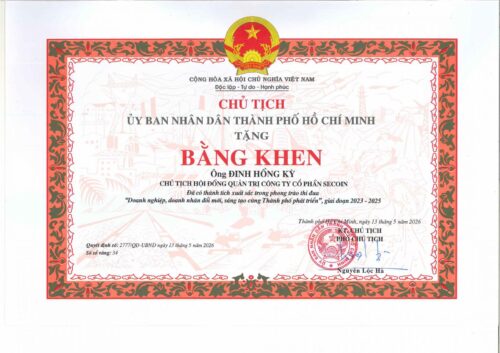
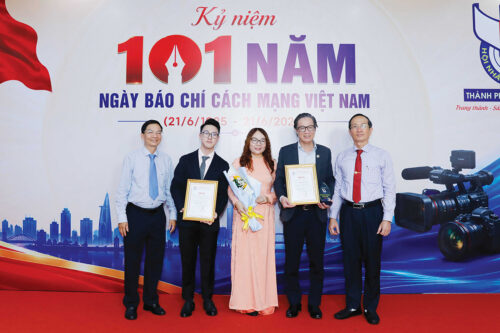
One fine day, Mr. Dinh Hong Ky, CEO of Secoin Joint Stock Company, received an investment proposal from SCG – the largest building materials corporation in Thailand. Right from the start, SCG stated that they wanted to acquire 60% of Secoin’s charter capital. “I outright rejected the offer, saying I had no intention of selling the company. We have always asserted that Secoin is a Vietnamese business and have built a strong Vietnamese brand,” Mr. Ky shared.
After that, SCG Group acquired 85% of shares in Prime Group, another major Vietnamese building materials company, for 7.2 billion baht, equivalent to 5,000 billion VND. Meanwhile, Secoin continued to receive numerous offers to buy shares from investors in Japan, Australia…
This comes as no surprise: while many domestic building materials companies were in sharp decline, Secoin consistently achieved annual revenue growth of 20–25%.
Over 24 years of development, Secoin has grown to include 9 companies, 5 factories, 2 forest plantations, and more than 800 employees. Each milestone of Secoin is closely tied to the name of its “captain” – Dinh Hong Ky.
The King of Non-Fired Bricks
Mr. Ky was born into a family of educators. His father, Associate Professor Dr. Dinh Xuan Ba, was once Vice President of the Vietnam Informatics Association and Head of the Department of Informatics at Hanoi University of Science and Technology.
After retiring, in 1989, Dr. Ba founded Secoin. Upon graduating from the Department of Automatic Control at Hanoi University of Science and Technology, instead of following in his father’s footsteps in education, Mr. Ky took over the family business.
In the 1990s, while people still widely used fired bricks to build homes, Mr. Ky imported a production line for non-fired bricks. As a result, Secoin’s first products not only failed to sell but also could not find any agency for testing or quality assessment.
In the fall of 1995, Mr. Ky and a group of journalists from Vietnam Television met with Dr. Tran Van Huynh, President of the Vietnam Association for Building Materials, to discuss developing the non-fired building materials industry in Vietnam.
Afterward, the team filmed Vietnam’s first non-fired block brick production plant in Phu Ly – Ha Nam, which was equipped and supported by Secoin.
Fifteen minutes after the program aired, Mr. Ky received a call from Mitsui Construction (Japan), who were building the five-star Horison Hotel (now Pullman Hanoi). According to the design, the building required concrete block bricks, but Mitsui couldn’t find any in Hanoi or nearby areas. Mitsui became Secoin’s first customer.
Since then, Secoin’s block bricks have been used in many projects across the country. Secoin has also supplied equipment and transferred technology to more than 30 non-fired block brick factories.
As the pioneer and driving force behind the development of non-fired bricks in Vietnam, Mr. Ky has been dubbed the “King of Non-Fired Bricks” within the industry.
Besides introducing non-fired bricks to Vietnam, he also sought ways to bring traditional Vietnamese tiles—encaustic cement tiles—to international markets.
The Preserver of Encaustic Cement Tiles
In 1997–1998, during a trip to Ho Chi Minh City, Mr. Ky saw that encaustic cement tiles were being sold at cheap prices, with poor quality and monotonous designs. Most of the traditional tile artisans had left the trade.
In contrast, abroad, Mr. Ky noticed these products were considered high-end and rare due to their handcrafted nature—something only the wealthy could afford.
In the Netherlands, France, and Germany, these tiles were sold at nearly €100 per square meter. While many Vietnamese people preferred foreign products, Mr. Ky focused on exporting items that were underappreciated in the domestic market.
He sought out former encaustic tile artisans while quickly establishing a factory in Binh Duong to produce high-quality, high-priced export products.
However, at first, he faced fierce competition from China. Upon investigation, he discovered that China’s products were cheaper because of large-scale production.
To compete, there was no other way—Secoin had to scale up and improve quality using technology from Switzerland, Germany, and the U.S.
Today, Secoin operates two encaustic tile factories in Binh Duong and Ho Chi Minh City. Exports account for 45% of Secoin’s total output. By 2014, this figure was projected to rise to 60%.
Even though the price of Secoin’s encaustic tiles is now eight times higher than before and nearly double that of other domestic producers, international customers still buy them.
“Our export order schedule is fully booked until January 2014,” Mr. Ky shared. Currently, 95% of Secoin’s encaustic tile output is exported to 41 countries.
After countless business trips between countries and factories, Mr. Ky spends his spare time reading. “Many people enjoy exercising their bodies, but I like to exercise my mind,” he said.
Although he’s a technical person, many people know him as a writer. “Even though I loved and was good at math, I was once selected to compete in Hanoi’s city-level literature contests. Later, as an entrepreneur, I traveled extensively, met many people, and encountered many thoughts and concerns. I wanted to share those reflections with others, so I began to write,” Mr. Ky said.