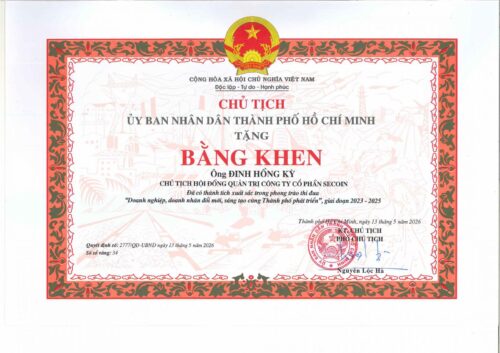
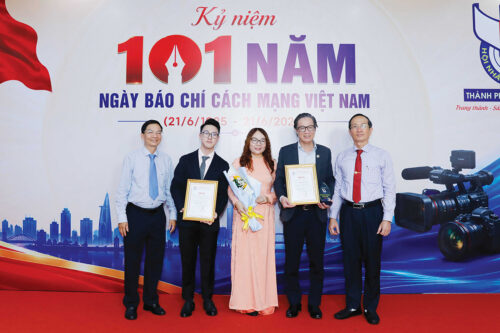
(Construction) – In recent years, with government incentive policies and rising market demand, many businesses have rushed to invest in production lines for non-fired building materials. However, nearly 20 years ago, Secoin Building Materials Corporation was already a pioneer in this field—investing early in the production of non-fired building materials—and has since maintained its position as one of Vietnam’s leading enterprises in this sector.

Introducing concrete block bricks into Vietnam
Explaining Secoin’s early entry into the field, Mr. Đinh Hồng Kỳ – CEO of Secoin – shared: “In the early 1990s, while managing the Secoin system in Europe, I observed that non-fired construction materials were widely used. Recognizing early on the inevitable trend of developing non-fired materials and environmentally friendly products, I was determined to bring both the production technology and non-fired building materials to Vietnam when I returned to take on the role of CEO of Secoin in 1995. That same year, the first non-fired concrete block brick factory in Vietnam—equipped and supported by Secoin’s technology transfer—was established in Phu Ly (Ha Nam).”
By a stroke of fate, shortly after VTV1 aired a program about Vietnam’s first non-fired building materials factory—less than 15 minutes into the broadcast—Mr. Kỳ received a phone call from a Japanese construction contractor: MITSUI Construction. They were building HORISON, the first 5-star hotel in Hanoi. According to the foreign design, the project required the use of concrete block bricks, but despite searching all over Hanoi and nearby areas, they couldn’t find this type of brick. That led to a contract between Secoin and the Japanese contractor to supply all the concrete block bricks for the construction of HORISON (now renamed Pullman Hanoi), marking the first project in Vietnam to use concrete blocks.
Since then, Secoin’s concrete blocks have been used in numerous projects across the country. Most notably, they were used in Vietnam’s tallest building, the Keangnam Hanoi Landmark Tower. Secoin has also provided equipment and technology transfer for more than 30 non-fired concrete block brick factories nationwide.
The Birth of the Terrazzo Tile Product Line
During a visit to Italy, Secoin was captivated by a type of unbaked tile manufacturing technology that resembled Vietnam’s traditional granito tile but with a more refined, high-end finish. Inspired by this, Secoin decided to invest in its first factory in Cau Dien (Hanoi) in 1999 and officially named the product line “terrazzo tiles.”
At that time, Hanoi was preparing to celebrate the 990th anniversary of Thang Long – Hanoi and was seeking a special type of tile to pave the walking paths around Hoan Kiem Lake. For terrazzo tiles to be approved for the project, Secoin had to go through a process requiring approval from 30 different authorities.
Since then, a trend of investing in and using terrazzo tiles has blossomed across the country. Today, there are more than 150 factories of various sizes producing terrazzo tiles in Vietnam. The tiles have become a standard choice for sidewalk paving across all 63 provinces and cities. Not only widely used domestically, Secoin’s terrazzo tiles are also exported to 20 countries. In Japan alone, nearly 30% of the outdoor tiles sold in building material supermarkets are made by Secoin.
Interestingly, the term “terrazzo” was coined by Secoin when it first introduced the technology and product to Vietnam 16 years ago. After registering it as a trademark, the name has since become the generic term for this type of tile in the local market.
In 2004, Secoin continued its pioneering path by importing technology and investing in a wet-press colored cement roof tile factory from Japan—another type of non-fired construction material. Since then, Japanese technology-colored roof tiles have spread throughout Vietnam, with over 60 manufacturing plants now in operation.
Reviving Cement Tiles (Encaustic Tiles)
If Secoin was the first company to introduce and manufacture the previously mentioned products in Vietnam, then with cement tiles, Secoin played a pioneering role in reviving and restoring a traditional craft.
By the late 1990s, cement tiles were in decline due to the rising popularity of ceramic tiles. Their quality deteriorated, designs became monotonous, and prices dropped. Meanwhile, in foreign markets, cement tiles were considered premium, handmade products—luxurious and rare, typically used only by the wealthy. Cement tiles in countries like the Netherlands, France, and Germany were sold for nearly €100 per square meter, while in Vietnam, they were being sold at just around 60,000 VND per square meter (approximately €2), with significantly lower quality.
Determined to restore the value of this traditional product, Mr. Đinh Hồng Kỳ traveled throughout Ho Chi Minh City and neighboring provinces to find and recruit skilled veteran cement tile artisans for Secoin’s first cement tile factory in Binh Duong. Secoin’s target market was the high-end segment—premium quality tiles sold at premium prices, primarily for export.
After seven years of dedicated effort, Secoin has now developed two cement tile factories located in Binh Duong and Ho Chi Minh City and is recognized as the world’s largest cement tile manufacturer. Secoin has incorporated advanced chemical technologies from Switzerland, Germany, and the United States to elevate the quality of its cement tiles to a new level. As a result, even though Secoin’s cement tiles are priced eight times higher than before and nearly twice the price of current domestic competitors, international clients still need to place orders three months in advance to secure supply.
Currently, 95% of Secoin’s cement tile production is exported to 42 countries across all continents.
Continue Developing Non-Fired Building Material Product Lines
Pioneering and consistently leading in the production of non-fired building materials, Secoin has established a network of five factories across Vietnam, from North to South, and has introduced to the market more than 10 product lines of non-fired building materials. These include colored roof tiles, wall blocks, pavement tiles, outdoor decorative tiles, swimming pool tiles, garden tiles, architectural concrete, indoor terrazzo flooring, and encaustic cement tiles.
Despite this, Mr. Dinh Hong Ky emphasizes that non-fired building materials should not be seen merely as a replacement for traditional fired materials, but rather as a complementary solution. Non-fired materials are not only for construction purposes but also applicable to roofing, ceilings, and decoration. Therefore, businesses must diversify their investments and remain flexible in production to ensure stability, especially amid today’s economic downturn.
Mr. Ky shared: “A good business not only generates profit for itself but must also contribute to solving social issues. Creating environmentally friendly, recyclable, and sustainable products is a standard in developed countries. This is also the guiding principle for all products manufactured by Secoin.”
Between 2014 and 2020, Secoin continued to focus on the production of non-fired building materials, diversifying and differentiating its product lines. “Secoin’s non-fired building materials must embody the essence of knowledge, technology, nature, and humanity—with a green mission,” Mr. Dinh Hong Ky affirmed.
http://www.baoxaydung.com.vn/news/vn/vat-lieu/tien-phong-phat-trien-vlxd-xanh.html