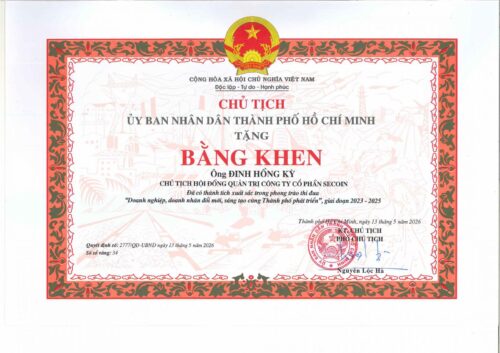
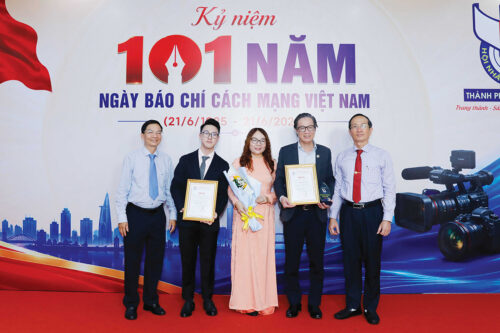
(DĐDN) – – Throughout the 25-year journey of establishment and development of Secoin Building Materials Corporation, Mr. Dinh Hong Ky, Chairman of the Board and CEO, along with the company’s co-founders, have made tireless efforts to develop a rich and diverse range of non-baked building materials to contribute to national construction and help create a “green economy.” As an outstanding nominee of the 2014 EY Entrepreneurial Winning Women Awards Program, he is also recognized for his philosophy of preserving traditional cultural values in Vietnamese-branded products as part of his business mission.


Graduating in 1988 with a degree in Automatic Control from Hanoi University of Science and Technology, Mr. Dinh Hong Ky joined Secoin from its very first days of establishment. Building his business career with the philosophy “For a Knowledge-Rich Enterprise,” after 25 years, Mr. Dinh Hong Ky and the members of the company take pride in what they have contributed to the community—economic value, social value, and the preservation of cultural traditions that Secoin represents.
In recent years, Secoin’s revenue has consistently grown at a rate of 20–25% per year. The export ratio has steadily increased, and by 2014, it is expected to account for nearly 60% of the company’s total revenue.
– Why did you and the founding members of Secoin choose to focus strongly on developing the export market rather than the domestic market right from the early days of the company’s establishment?
From the very early days of its establishment, the founders of Secoin embraced a “borderless” vision, clearly reflected in the strategic approach: “Reaching out to the world to unlock domestic potential.” On the other hand, the domestic market, while seemingly large due to its population, actually has limited purchasing power. Exporting also offers greater financial security, especially in the context of serious issues with bad debts and unsettled payments in the domestic construction sector.
– With such a strategic direction, how extensive is Secoin’s current “global footprint”? In your opinion, which is the most “demanding” market?
Currently, Secoin’s products are present in 45 countries across five continents. Most of our customers are from developed nations such as countries in Europe, Japan, the Middle East, the United States, Australia, and others. Each market presents its own unique challenges and advantages.
One of the most demanding markets is Japan. Japanese clients are known for their seriousness, high-quality standards, strong business etiquette, and persistence. We began exporting to Japan in 1999 with a modest export volume. By 2013, exports accounted for over 45% of the total production across Secoin’s entire system from North to South Vietnam. For cement tiles in particular, exports accounted for 95%.
We’ve learned a great deal from our Japanese partners. If you can successfully export to Japan, you likely have the ability to export to any other market in the world.
– So, what are your key lessons or experiences when it comes to “bringing the bell to ring in a foreign land,” sir?
An excellent enterprise is not only one that generates wealth for itself, but also one that contributes to solving the problems of society and humanity.
To succeed in foreign markets, we must understand what they need and what we have to offer. We must produce what they require, not merely what we like to make. Take Secoin’s cement tiles as an example. At one time in Vietnam, cement tiles were considered low-end, cheap products used only by low-income earners. However, from the perspective of developed countries, these are handcrafted products with natural beauty and high artistic value. That’s why, when we confidently developed this product to suit their tastes and incorporated advanced technology to achieve high-quality tiles, the result was a growing acceptance of the product. The number of export markets will not stop at 45—it will certainly continue to grow.
Thanks to the success of our exported cement tiles, we’ve learned an important lesson: as we integrate into the global market, we must position Vietnamese products properly. It’s difficult for us to compete globally in areas like airplanes, cars, computers, or steel. But if we can build strong brands for products like rice, coffee, cashews, handicrafts, and cement tiles, we can create our own unique value on the global stage. We shouldn’t aim for things too grand and risk losing our own strengths and distinctive values.
– Could you share Secoin’s development strategy going forward and your next breakthrough?
Secoin’s development strategy for the 2014–2020 period is to continue focusing on the production of non-fired building materials and to maintain our position as the leader in this field—not just in Vietnam, but across Southeast Asia.
To remain a pioneer, Secoin must diversify and differentiate its range of non-fired building materials. Beyond the current product lines, Secoin will continue to develop new lines of non-fired building materials. For each existing line, new designs and models will be introduced. These new products will be developed based on the integration of knowledge, technology, nature, and people, all under the principle of “green.”
The guiding philosophy throughout Secoin’s journey is: An excellent enterprise is not only one that generates wealth for itself but also one that contributes to solving society’s and humanity’s problems. The greatest challenge we currently face is environmental and climate issues. Producing environmentally friendly products that protect the planet and are recyclable is a standard in advanced countries—and it’s also the standard Secoin upholds in its products.
– With such a demanding workload, what personal hobbies help you relieve stress?
My favorite activities are reading and writing. Many people enjoy physical exercise for their bodies—I prefer exercising my brain!
– Thank you very much!
(This article was created in collaboration with the 2014 “EY Entrepreneurial Winning Women” Award Program.)