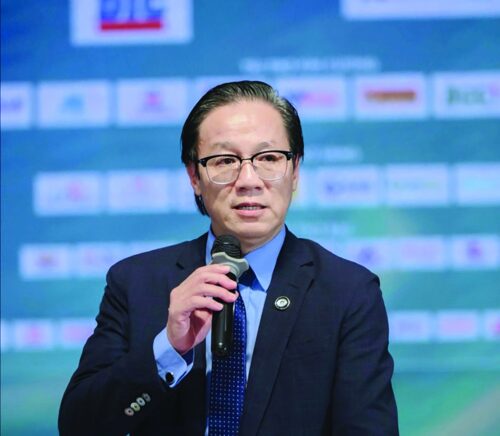
The Vietnam National Brand Forum 2021 was organized by the Vietnam Trade Promotion Agency – Ministry of Industry and Trade on April 19, 2021, in Ho Chi Minh City. As the sole representative among the 124 enterprises recognized as Vietnam National Brands for the 2020–2022 period, Mr. Dinh Hong Ky – Chairman of Secoin – delivered a presentation on the topic: “Elevating the Position of Vietnamese Brands on the Global Value Chain Map.”
Mr. Dinh Hong Ky’s speech focused on key topics including insights into the current position of Vietnamese brands, solutions to elevate their global standing in the future, and real-life stories from Secoin’s journey in bringing artistic tiles to over 60 countries across six continents. He also addressed the opportunities and challenges facing Vietnamese brands in the post-COVID era.

The forum attracted the participation of numerous experts and businesses.
Where do Vietnamese brands stand in the global market?
To assess the position of Vietnamese brands in the international market, both external objective observation and internal analysis are required. According to Brand Finance’s Nation Brands 2020 Ranking, Vietnam ranked 33rd in 2020—an impressive rise of 9 positions compared to 2019.
The report states: “Vietnam is the fastest-growing national brand in this year’s ranking, with brand value soaring by 29% to USD 319 billion. Vietnam, which recorded remarkably low numbers of COVID-19 cases and deaths, has emerged as one of the top manufacturing destinations in Southeast Asia and is increasingly becoming an attractive location for investors.”
In terms of the Global Soft Power Index 2021, Vietnam was the only ASEAN country to rise three spots from 2020, moving up from 50th to 47th place.

Mr. Dinh Hong Ky – Chairman of Secoin – shared his insights at the forum.
Meanwhile, to evaluate countries around the world, FutureBrand—a reputable global brand transformation company—released the FutureBrand Country Index 2020. This report is based on six main criteria and 22 factors that provide a comprehensive assessment of a nation’s overall image. The six criteria include: Tourism; Heritage and Culture; Quality of Life; Business Potential; Value System; and “Made in” (the country’s products).
According to the report, Vietnam ranked 66th, dropping 5 places compared to its 61st position in 2019 and 64th in 2014.
Elevating the Position of Vietnamese Branded Products and Stories from Secoin
A noteworthy element in the FutureBrand Country Index 2020 is the “Made in” criterion, which assesses the authenticity, quality, and uniqueness of a country’s products, as well as consumer willingness to buy products from that country. According to Mr. Dinh Hong Ky, when building Vietnamese product brands in the global market, businesses should pay close attention to the “Made in” factor. During his presentation, he shared stories from Secoin’s journey in conquering international markets, focusing on elements aligned with this important criterion.
Regarding the “authenticity” of Secoin’s products, the story of Secoin encaustic cement tiles, with a tradition dating back to 1910, serves as a clear example of a truly Vietnamese product highly valued for its artistic uniqueness, handcrafted by Vietnamese artisans, and carrying deep cultural and historical significance across generations. The reputation of Vietnamese cement tiles has even surpassed countries such as Spain, Morocco, Mexico, and Brazil. This authenticity has helped Secoin earn strong recognition in the eyes of international customers.
To achieve “uniqueness” and “novelty” in its products, Secoin has collaborated with renowned designers from the U.S. and Europe to create exclusive collections. The company has also partnered with Swarovski, the world’s leading crystal brand, to develop a handmade tile line combining Secoin craftsmanship with precious stones.
Regarding “quality,” Secoin has swiftly aligned with global business standards, including establishing a quality management system; conducting assessments of social responsibility, work environment, labor safety, and employee welfare; and ensuring that its products are environmentally friendly.
Are global consumers willing to buy products bearing the Vietnamese brand?
To answer this, Mr. Dinh Hong Ky shared Secoin’s journey of gradually bringing its artistic tiles to the global market—starting with the message “Made in Vietnam” and later evolving to “Made by Secoin in Vietnam.”
The “Made in Vietnam” Story: “I recall in 2010, we visited and worked with customers in European countries like the Netherlands, France, and Germany. At that time, most of our customers in developed countries were hesitant when it came to the Vietnamese origin of the cement tiles. Since there were no mandatory regulations on labeling the country of origin back then, many customers avoided mentioning Vietnam and instead used visuals related to Portuguese, Mexican, or Moroccan tiles. The Vietnamese tile brand seemed to be overshadowed by others, even though our product quality was superior. We had to patiently introduce our products step by step into the market, seizing every opportunity to incorporate our logo and the phrase ‘Made in Vietnam.’ By the end of 2020 and early 2021, Vietnamese cement tiles had risen to the number one position globally, and our clients in Europe, the U.S., Canada, and beyond began proudly promoting ‘Made in Vietnam’ tiles as an added value for artistic interior and exterior design products.”
The “Made by Secoin in Vietnam” Story: “Twelve years ago, Sven Erik, a Secoin customer from Norway, came to Vietnam to discuss the distribution of cement tiles in Norway and the Nordic region. After nearly a week of intense negotiations, both sides reached agreement on most terms. The topic that took the most time to discuss was branding for market entry. Secoin wanted to use its own brand—a purely Vietnamese brand with over 20 years of heritage—while the partner preferred using their own brand. In the end, Secoin proposed a solution: the partner would become the exclusive distributor in Norway, provided that the packaging included a small line stating ‘Made in Vietnam’ and featured the Secoin brand name. The partner accepted this proposal, and as a result, the ‘Made in Vietnam’ cement tile brand began to appear in the Nordic market.”

“How can we build the image of products that are designed/developed and made in Vietnam?”
“How can we ensure that tiles designed and manufactured by Vietnamese people reach consumers under a Vietnamese brand name?”
These are the two big questions Mr. Dinh Hong Ky is posing to his company, as he strives to advance further on the global value chain map.
Opportunities and Challenges for Vietnamese Brands in the Post-COVID-19 Era
In addition to the severe impacts on society, the COVID-19 pandemic has also created certain opportunities for Vietnamese businesses in the global market. The evolving global environment and growing adoption of online business practices have opened up avenues for Vietnamese companies to build brand visibility and reach international consumers more quickly.
For the construction and building materials sector, Mr. Dinh Hong Ky cited the example of Secoin’s export growth as global demand for home renovation and construction surged in many countries. He pointed to the company’s distribution systems in Japan and France, both of which achieved a 20% growth rate in 2020—a rare achievement amid the global economic downturn.
However, alongside these opportunities come major challenges for all Vietnamese enterprises. The COVID-19 pandemic has been likened to an environmental crisis, prompting large multinational corporations to accelerate their transition toward a circular economy. Mr. Dinh Hong Ky shared an example involving a global supply chain comprising over 3,000 suppliers and more than 4 billion products per year, in which Secoin participates as a supplier.
This global corporation has initiated meetings and guidance sessions with its suppliers regarding two key programs: Positive Products and Solar Impulse. For Vietnamese brands to remain part of such supply chains long-term, they must adapt and build their systems in alignment with the goals of these programs.
The “Positive Products” Program – Based on 5 Core Principles:
-
Safe for both people and the planet
-
Made from renewable and recycled materials whenever possible
-
Responsibly manufactured with respect for human rights, labor rights, and pollution prevention
-
Durable and long-lasting in use
-
Designed to enhance environmental performance in homes, such as water and energy efficiency
The “Solar Impulse” Program – Evaluated Based on 5 Criteria Grouped into 3 Main Themes:

Given the significant emerging challenges, Mr. Dinh Hong Ky proposed that the Ministry of Industry and Trade and the Vietnam Trade Promotion Agency (VIETRADE) should consider referencing the Positive Products and Solar Impulse programs to develop new criteria for the Vietnam National Brand Program in the post-COVID-19 era.

Mr. Ky referred to an objective assessment by Brand Finance regarding the Vietnam National Brand Program:
“Thanks to the efforts of the national branding program named ‘Vietnam Value,’ Vietnam’s processed food industry now contributes up to 17 billion USD in exports. The garment industry accounts for over 22 billion USD in export value. These economic contributions are extremely important to Vietnam’s overall growth and would not be possible without the focused efforts of the Vietnamese government. A well-managed national brand is the key to success and can bring tremendous benefits.”