An article by Mr. Đinh Hồng Kỳ, published in Doanh Nhân Sài Gòn on February 5, 2026.
When the VnExpress fanpage posted images of the area in front of Bến Thành Market after its recent renovation, a short comment in English quickly drew attention: “A shame to consider artistic public spaces of Saigon as Disneyland.”
Roughly translated: “It is a shame to consider Saigon’s artistic public spaces as Disneyland.”
This remark was made by Olivier Souquet, a French architect and urban planning expert who has lived and worked in Vietnam for many years. Having participated in numerous major urban projects, he possesses a deep understanding of the spatial structure, history, and rhythms of Vietnamese cities.
The sentence was neither long nor harsh; in fact, it carried a tone of regret rather than outright criticism. Yet precisely because of its brevity, it struck at the heart of a much larger issue: when renovating public spaces—especially those associated with heritage—are we viewing the city as an amusement park, or as a living organism that deserves respect and the nurturing of collective memory?
Disneyland, in itself, is not a negative concept. It is a symbol of the global entertainment industry, where vibrant colors, bold forms, and visual effects are designed to generate immediate emotional responses. Disneyland serves its purpose well: delivering quick joy, short-term experiences, and carefully controlled excitement within an enclosed environment.
The problem begins when this mindset is applied to urban public spaces, particularly those tied to historical identity. Bến Thành Market is not merely a marketplace or a tourist attraction. It is a memory landmark of Saigon–Ho Chi Minh City, an image associated with generations of residents, a structure so recognizable that its red-tiled roof and clock tower alone immediately evoke the city. In spaces like this, every intervention is not just a matter of aesthetics, but a statement about how a city dialogues with its own history.

Painting the plaza in front of the market with large patches of blue, turquoise, and white undeniably creates a strong visual impact. It is eye-catching, highly noticeable, and very “photogenic” from above. In the age of digital media, such images spread rapidly, conveying a sense of a dynamic, youthful, and ever-changing city. Yet this is precisely where another question must be asked: who is the main protagonist of this space?
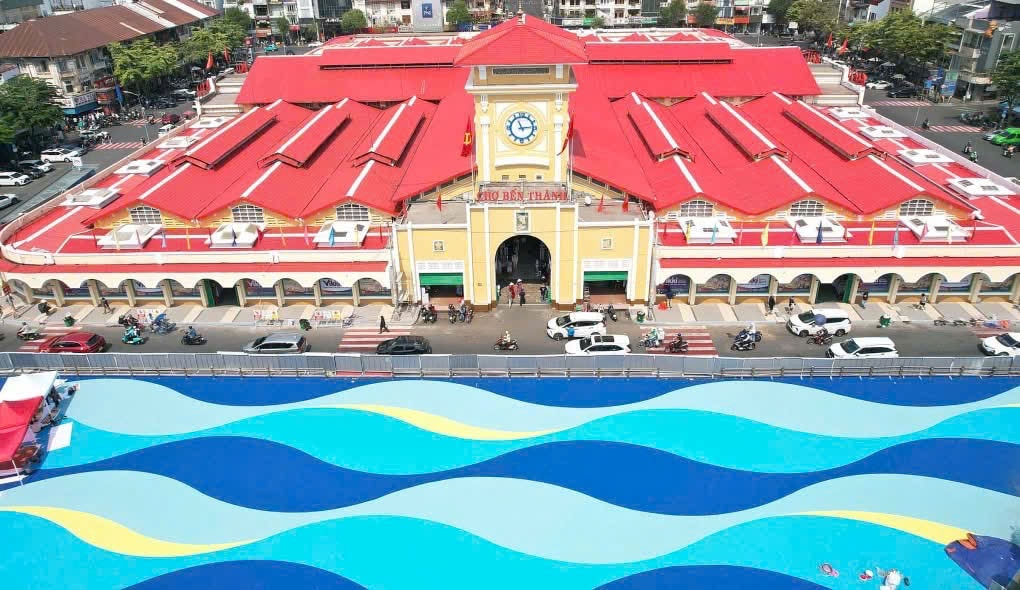
When an image is designed to evoke the waterways of the Mekong Delta, yet is perceived by many viewers as a collection of garish and disconnected patterns, it reveals a gap between design intent and community experience. Incorporating geographical or historical symbols into public-space design is commendable. But the key question remains: are these memories and symbols conveyed in a harmonious and refined manner, or are they reduced to fleeting visual entertainment?
In heritage-oriented urban conservation thinking, plazas and open spaces in front of historic buildings are often treated as a backdrop. Their role is to highlight the architecture, to provide visual breathing room, and to create an emotional space where historical depth can be felt. When the backdrop becomes overly prominent, overly performative, the roles are reversed. Heritage retreats into the background, becoming a mere stage set for short-term activities, check-in photos, or instant media effects.
This is what many architects and planners refer to as the “Disneyfication” of cities. Not because the city becomes ugly, but because it is reduced to a sequence of rapid visual experiences. Public space is treated as a continuous event stage, where liveliness is prioritized over contemplation, where novelty must impress immediately rather than prove its value over time.
Importantly, this debate should not be narrowed to a simple matter of liking or disliking colors. Color itself is not at fault. The issue lies in the approach. In urban renovation, we are often swept up by pressure to “make it different,” “make it stand out,” “make the results visible immediately.” Under such conditions, short-term visual impact easily becomes the primary measure of success.
But a city, unlike a media campaign, does not end after a few weeks or months. It is a living environment for millions of people over decades.
So when a city is “Disneyfied,” who loses the most? Not necessarily tourists. They arrive, take photos, leave, and carry away only a fleeting impression. Not necessarily authorities or project implementers, since short-term goals of refreshing the image and attracting attention are still achieved. The ones who lose the most are urban residents—the people who live with these spaces every day.
“When a city is ‘Disneyfied,’ those who lose the most are the residents—the people who live with that space every day.”
They gradually lose places for pause and reflection, for sensing the continuity of time. They lose symbols capable of nurturing long-term civic pride, replaced instead by images that shift constantly with changing tastes. Over time, the city loses its ability to accumulate collective memory—the very substance that gives a city cultural depth.
Looking at cities with long histories such as Paris, Rome, or Kyoto, one can observe a common approach: plazas and spaces in front of heritage structures are treated with restraint. Neutral materials, subdued colors, minimalist patterns. This is not due to a lack of creativity, but because there is an understanding that creativity in heritage spaces must be accompanied by aesthetic discipline and respect for history.
A city, ultimately, is not an amusement park. It is where people live, work, grow old, and pass memories on to the next generation. A city’s lasting appeal does not come from instantly striking colors, but from its ability to make people want to return, to belong, and to feel proud to call it home.
The question “when cities are Disneyfied, who loses the most?” therefore extends far beyond a single project or location. It is a question about how we are choosing the aesthetic and cultural future of Vietnamese cities. And the answer likely does not lie in beautiful images on social media, but in the lived experiences of those who will share these spaces for many years to come.
(*) Vice Chairman of HUBA; President of the Ho Chi Minh City Green Business Association (HGBA); Chairman of the Board of Directors of Secoin Corporation; President of the Ho Chi Minh City Construction and Building Materials Association.
Link to the article on Doanh Nhan Sai Gon newspaper:: https://doanhnhansaigon.vn/khi-do-thi-bi-disneyland-hoa-332741.html