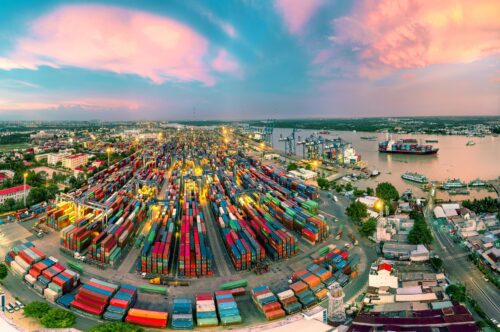
Article by Mr. Đinh Hồng Kỳ published in the Spring Edition of Saigon Entrepreneur Magazine (Quý Mão 2023), titled “Circular Economy: The Journey to Net-Zero.”
In early May 2022, our company received a request to complete a carbon footprint questionnaire related to our manufacturing processes from a French client — the third-largest global retail chain, with nearly 900 supermarkets distributing construction materials and interior/exterior decorative products worldwide.
As the concept of “carbon footprint disclosure” was still relatively new to most Vietnamese enterprises, the client further explained:
“Declaring the carbon emissions generated at the factory during the production process is one of the essential activities to reduce pollution, create Positive Products, and contribute to the development of a circular economy. This is a mandatory requirement for manufacturers wishing to join our supply chain in the future.”
At that moment, one key question came to my mind:
“Where do Vietnamese businesses in general, and my company in particular, stand on the path toward a circular economy?”
In line with the UN’s goals, the Prime Minister of Vietnam issued a National Action Plan to implement the 2030 Agenda for Sustainable Development, which sets out 17 sustainable development goals and 115 specific targets. These goals not only aim to protect the global climate but also address many of the challenges facing humanity — such as biodiversity loss, global inequality, human-induced climate change, and the development of sustainable cities.
In December 2021, at the COP26 Conference, Vietnam joined nearly 150 other countries in committing to achieve net-zero carbon emissions by 2050. To fulfill this pledge, the Vietnamese government issued the National Action Plan on Green Growth for the 2021–2030 period, along with the National Climate Change Strategy to 2050.
General Concept of Circular Economy (CE) and 10 Circular Investment Opportunities for Businesses
The COVID-19 pandemic has exposed the weaknesses of the linear economy and served as a powerful catalyst, urging humanity to urgently build a circular economy. The operations of businesses play a pivotal role in the transition from a linear model (produce – use – dispose) to a circular model (produce – use – repair/recycle/reuse).
Simply put, for businesses, the circular economy is a closed-loop system that minimizes the use of resources and energy as input materials, generates no carbon emissions or pollutants during production, and avoids creating waste at the end of the product’s lifecycle—instead, products are repaired, refurbished, or recycled to begin a new lifecycle.
During the post-COVID economic recovery phase, governments around the world are investing massive amounts of capital to stimulate the economy toward a circular model. Although there are many investment opportunities during this recovery period, it is essential to consider the most necessary investment solutions to meet the Sustainable Development Goals (SDGs) and climate change mitigation objectives.
According to the Ellen MacArthur Foundation, there are 10 key circular investment opportunities, spanning across five major sectors:
-
Construction: Build quality housing with low-carbon materials and costs; reuse and recycle building materials; renovate and upgrade buildings.
-
Transportation: Develop an interconnected, low-carbon, resilient transport system; establish multimodal infrastructure; refurbish, remanufacture, and repair vehicles.
-
Plastic Packaging: Shape a more competitive and less polluting plastic packaging industry; promote innovative reuse business models; improve plastic collection, sorting, and recycling infrastructure.
-
Fashion: Create a low-carbon fashion industry that encourages reuse; develop rental and resale models for clothing; enhance textile collection, sorting, and recycling infrastructure.
-
Food: Build a regenerative, healthy, and safe food system; provide tools to help farmers transition to regenerative agriculture; collect surplus food and by-products; optimize food distribution and pricing.
Take construction as an example. The construction industry is one of the most environmentally damaging sectors globally, directly affecting raw material consumption. However, in Vietnam, the transition of construction businesses from a linear to a circular economy is still in its early stages.
A key component of circularity in construction is the renovation and upgrading of buildings at the end of their lifecycle. This means selectively dismantling parts of a building with the foresight of reusing (fully or partially) or recycling them in the future—a sustainable alternative to conventional demolition. In a linear economy, demolishing a building at the end of its life may seem faster and cheaper, but it generates a massive amount of waste, severely impacting the environment and contradicting the goal of a circular transition.
Green/Sustainable Supply Chains in the Circular Economy
Transitioning from a linear to a circular economy requires the close participation and collaboration of all actors in the supply chain, including Sub-suppliers, Suppliers, Companies, Customers, and Consumers. These stakeholders must recognize and act upon the need to shift from Linear Supply Chain Management (SCM) to Green Supply Chain Management (GSCM)—a system where resources are preserved for as long as possible and waste is minimized at every stage, from design to distribution.
The Green Supply Chain (GSCM) model illustrates each link in the circular chain. All these links must be aware of their own transformation from linear to circular.
From the initial design phase, factories should be planned with energy-saving criteria, zero waste strategies, minimal environmental risk, improved service and product quality, and reduced production costs. In the procurement and supply phase, emphasis should be placed on choosing contractors with eco-friendly materials that are non-toxic and safe for human health.
Green production, packaging, and warehousing should form an efficient, non-polluting system using recycled packaging and solar-powered warehouses. Green logistics, as a cross-cutting activity in the supply chain, must aim for optimal transport efficiency, reduced carbon emissions, and lower noise pollution.
If any link in the supply chain fails to meet the criteria of green and sustainable practices, it will not be possible to establish a truly circular supply chain.

Returning to the distribution system in France, our company is participating in this global supply chain, which imposes very strict requirements for Secoin artistic tiles and roofing products. To ensure green and circular standards for the supply chain, our partner has introduced a “Positive Products” program based on five core principles:
-
Products must be safe for both people and the planet;
-
Made from renewable and recycled materials whenever possible;
-
Responsibly produced with respect for human rights, labor rights, and pollution prevention;
-
Designed for durability and long-term use;
-
Designed to improve environmental performance indoors, such as water and energy efficiency.
To meet these criteria, we must develop a circular transformation roadmap at every stage—from product design and development, raw material procurement, production, packaging, to the selection and use of external logistics services.
The challenges are many, but they also present great opportunities for our products to secure a long-term and sustainable position in the global green supply chain.

Programs like the supply chain initiative being implemented in France are also part of the broader European framework aimed at becoming a climate-neutral continent by 2050 and applying the Carbon Border Adjustment Mechanism (CBAM). Currently, Vietnam ranks 11th among import partners of the EU. The EU’s CBAM could have a significant impact on Vietnamese export enterprises in the near future. Businesses must begin preparing now to respond to this regulation, especially manufacturers in high-risk sectors such as steel, aluminum, oil refining, cement, paper, glass, fertilizer, and energy that export to the EU market. These companies should develop strategies to reduce carbon emissions in the production process in order to meet EU standards.
Industrial Symbiosis
Each enterprise may have its own approach to the circular economy model depending on its operational realities. However, one critical solution is industrial symbiosis, which helps foster a community of circular enterprises. Industrial symbiosis is an innovative approach that brings together companies from different industries to convert waste into energy and/or materials, including water.
In other words, within a symbiotic relationship, the waste output of one company becomes the input resource for another. This symbiosis creates added value and allows for the sustainable management of industrial and urban waste and by-products.
Industrial symbiosis has been implemented in developed countries in recent years. For example, Denmark’s “Sustainable Synergies” project in 2020 brought together 25 Danish companies to exchange surplus resources such as water, energy, or materials. The direct benefits included:
-
Reduced costs of material procurement and waste management
-
Increased income through product innovation and new products
-
Creation of new markets and/or customer groups
-
Positive environmental outcomes, such as reduced energy and material consumption and decreased CO₂ emissions
In Vietnam, industrial symbiosis is also beginning to emerge. For instance, in the Nam Cau Kien Industrial Zone, businesses have formed a circular business community with an industrial symbiosis model applied to three sectors: metallurgy–mechanics, plastics, and electrical support industries.
Current business models in Vietnam still largely follow a linear approach, and we are only just beginning the journey toward a circular economy. There is no one-size-fits-all formula for businesses moving toward circularity. However, with growing awareness of the importance of the circular economy and the urgent need to create sustainable supply chains, each business must develop its own transition roadmap from “linear” to “circular.”
Especially in the context of the global market, Vietnamese enterprises must produce regenerative products that contribute to fighting climate change. Those that fail to adapt to global trends will only achieve short-term growth and will miss out on opportunities to participate in the global supply chain. Corporate performance will no longer be evaluated solely through financial reports, but also through new sets of criteria, such as Environmental, Social, and Governance (ESG) reports.
Creating positive and sustainable products is quickly becoming a social standard for evaluating a company’s or entrepreneur’s business ethics.
There are now less than 30 years—the span of a single generation—for our country to bring its net emissions to zero. This urgency calls for action from all sectors of society, with the business community playing a leading role. From an entrepreneur’s perspective, I believe that in the near future, only those businesses that offer “positive” products or services—ones that provide community value, consume minimal resources, and do not generate new carbon emissions—will truly be considered successful enterprises.
Chairman of Secoin Joint Stock Company