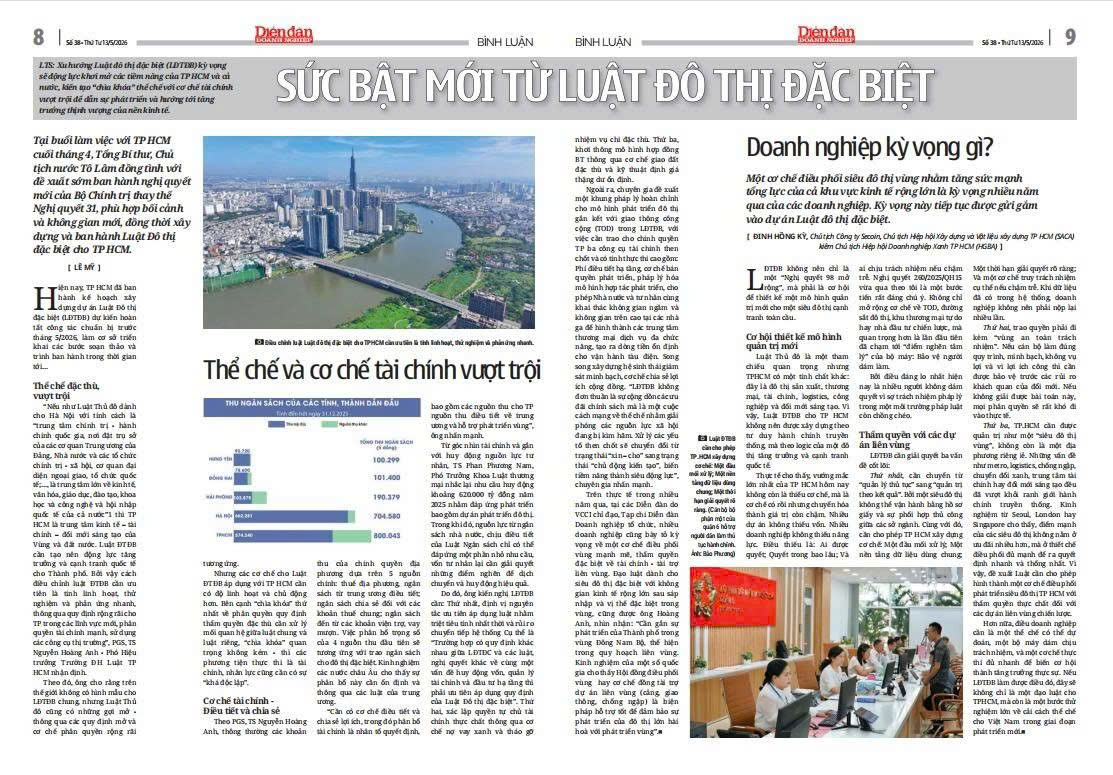
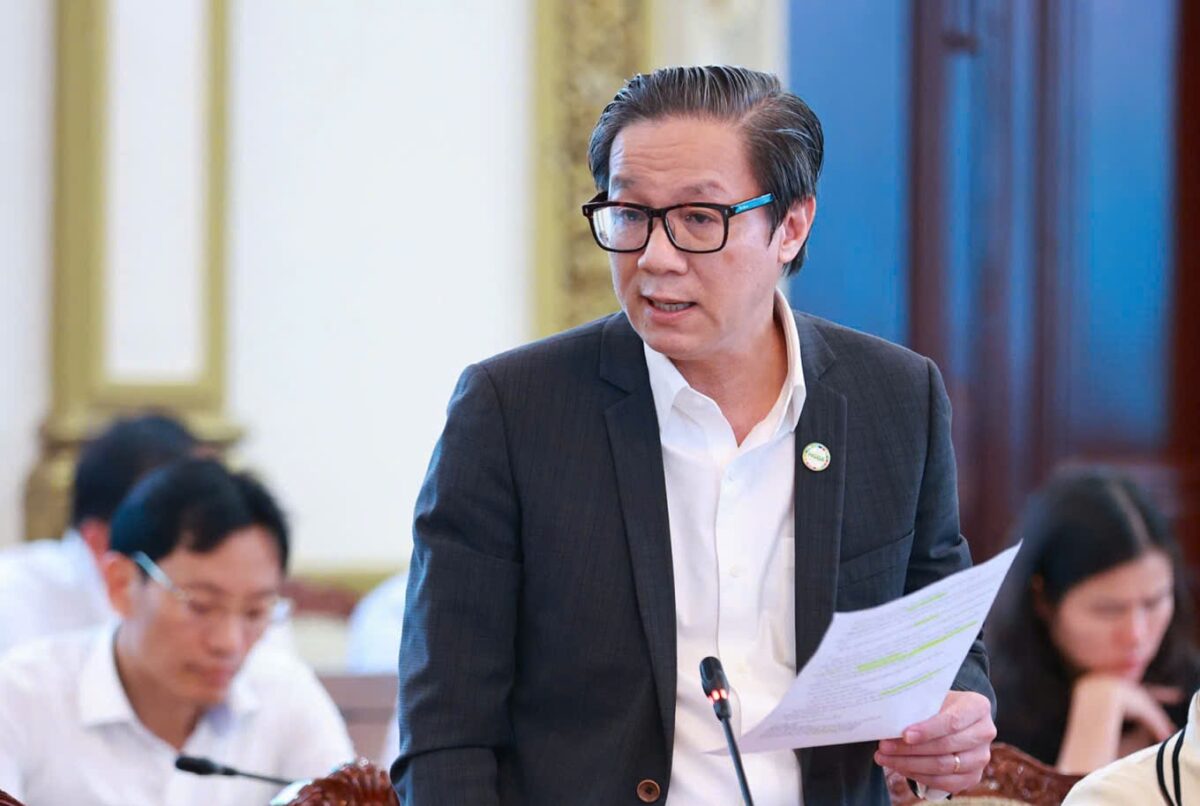
An article by Dinh Hong Ky, published in Dien Dan Doanh Nghiep newspaper on May 17, 2026.
A metropolitan coordination mechanism for the region, aimed at strengthening the overall power of the entire economic zone, has been a long-standing expectation of the business community. This expectation continues to be placed on the proposed Special Urban Law.
The Special Urban Law should not merely be an “expanded Resolution 98,” but rather an opportunity to design a new governance model for a globally competitive mega-city.
An Opportunity to Design a New Governance Model
The Capital Law is an important reference point, but Ho Chi Minh City possesses a very different character: it is a city of manufacturing, commerce, finance, logistics, industry, and innovation. Therefore, the Special Urban Law for Ho Chi Minh City should not be developed under a traditional administrative mindset, but according to the logic of a growth-oriented and internationally competitive metropolis.
In reality, the biggest bottleneck facing Ho Chi Minh City today is no longer the lack of mechanisms, but rather the slow conversion of existing mechanisms into tangible value. Many projects are not lacking capital. Many businesses are not lacking capability. What is lacking is clarity on: Who has the authority to decide; How long the decision-making process takes; And who is accountable for delays.
In my view, Resolution 260/2025/QH15 marks a very notable step forward. It not only expands mechanisms related to TOD development, urban railways, free trade zones, and strategic investors, but more importantly, it addresses for the first time the “psychological bottleneck” within the administrative system: protecting those who dare to take action.
Because the greatest concern today is that many officials hesitate to make decisions out of fear of legal responsibility in an environment where laws and regulations remain overlapping and inconsistent.

Authority Over Interregional Projects
The Special Urban Law needs to address three core issues.
First, governance must shift from “procedural management” to “results-based governance.” A mega-city cannot operate through paperwork and manual coordination among departments. At the same time, Ho Chi Minh City should be allowed to establish a mechanism with: one central processing authority, one shared data platform, one clearly defined timeline for resolution, and one transparent accountability mechanism for delays. Once data already exists within the system, businesses should not be required to repeatedly resubmit the same documents.
Second, decentralization of authority must go hand in hand with a “safe accountability zone.” If officials follow proper procedures, act transparently, avoid personal gain, and work for the public interest, they should be protected from the objective risks associated with innovation and reform. Without resolving this issue, decentralization will be very difficult to implement effectively in practice.
Third, Ho Chi Minh City needs to be governed as a “regional mega-city,” rather than as an isolated locality. Issues such as metro systems, logistics, flood prevention, green transition, financial centers, and innovation ecosystems have already exceeded traditional administrative boundaries. Experiences from Seoul, London, and Singapore show that the strength of mega-cities lies not in greater incentives, but in strong coordinating institutions capable of making fast and unified decisions. Therefore, the proposed law should allow the establishment of a metropolitan development coordination mechanism for Ho Chi Minh City with substantive authority over strategic interregional projects.
More importantly, what businesses truly need is a predictable institutional framework, an administrative system willing to take responsibility, and an implementation mechanism fast enough to turn opportunities into real growth. If the Special Urban Law can achieve that, it will not only be a law for Ho Chi Minh City, but also a major experiment in institutional reform for Vietnam in its next stage of development.
Link to the article on Dien Dan Doanh Nghiep: https://diendandoanhnghiep.vn/suc-bat-moi-tu-luat-do-thi-dac-biet-doanh-nghiep-ky-vong-gi-10178989.html