Mr. Dinh Hong Ky gave an interview in Doanh Nhân Sài Gòn, published on April 25, 2026.
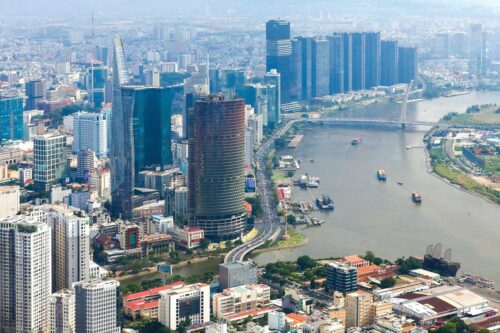
A Friday or Saturday evening in Ho Chi Minh City: Nguyen Hue Walking Street is packed with people. Bui Vien glows with lights and music. Visitors line up at Bach Dang Wharf to take the waterbus. Metro Line No. 1 carries crowds heading out for weekend entertainment. These scenes show that Ho Chi Minh City is a very “alive” city. But if we look more closely, a paradox appears: the city is crowded, yet it is not necessarily “earning well” from that crowd. People come and go, their stays are short, spending remains modest, and experiences are still fragmented.
WEEKENDS ARE NO LONGER JUST A BREAK
For years, Ho Chi Minh City has been organized as a five-day working metropolis. From Monday to Friday, the city revolves around production, trade, offices, and construction sites. Weekends were considered downtime. But as incomes rise, the middle class expands, and urban consumption habits evolve, weekends have become the peak period for spending — only now, spending is driven by emotion.
People no longer buy because they need to; they buy because they want to. They no longer go out for work, but for enjoyment.
This is where many cities in the region are already one step ahead. They no longer see weekends as the “extra” part of urban life, but as a separate economic cycle where commerce, culture, transportation, entertainment, and public spaces work together to keep people staying longer.
Singapore is a typical example. Marina Bay is not merely a check-in destination; it is an area activated year-round through a continuous calendar of events, waterfront promenades, public art, light festivals, and commercial activities.
THE BIGGEST CHALLENGE IS KEEPING PEOPLE AROUND
A young family from Thu Duc or Binh Duong can now travel into the city center by metro, stroll along Nguyen Hue, have dinner, and head down to Bach Dang Wharf. But after that, the journey often ends rather early. It is not because they do not want to spend more money, but because the city has not yet created a connected chain of experiences to keep them engaged longer.
This difference becomes very clear when compared to Bangkok. The city does not rely on just a few famous attractions; instead, it creates “experience clusters” that extend consumer activity over time. Bangkok Design Week, for example, is not confined to a single exhibition hall. It spreads across neighborhoods and districts, transforming the entire city into an immersive experience.
At the same time, Bangkok’s authorities are investing heavily in public spaces, with more than 50 parks and weekly activity programs under the Greener Bangkok initiative. This means weekends are no longer centered solely around shopping, but also connected to parks, community activities, wellness, and the environment.
The lesson is very clear: a city that wants a strong weekend economy cannot rely only on “crowded places.” It must create a “consumer movement flow,” guiding people from one destination to another, from one activity to the next.
During weekdays, businesses compete through speed, pricing, and efficiency. On weekends, businesses compete through emotion, atmosphere, and quality of experience.
A café is not crowded simply because the coffee tastes good. A street is not busy simply because it sells products. A metro line is not full simply because it is convenient. All of it happens because people feel it is worth going, worth staying, and worth returning to.
THE GREATEST OPPORTUNITY LIES WITH SMALL BUSINESSES
If examined more deeply, the weekend economy is not built by mega-projects, but by a very different force: small businesses, household enterprises, and independent creative models.
A café with its own unique concept, a late-night food cart, a handicraft stall, a small art space, a street music group — all of these seemingly small elements create tremendous value when connected together.
Looking again at Bangkok, what keeps people there is not only shopping malls, but also night markets, food streets, and creative spaces woven into every neighborhood.
In fact, Ho Chi Minh City holds a major advantage in this area. The city already has an extremely dynamic, flexible, and creative ecosystem of small businesses and household enterprises. However, this ecosystem is still operating without truly supportive conditions.
If this challenge is not addressed, the weekend economy will remain merely “crowded,” rather than becoming a sustainable flow of revenue.
QUALITY OF LIFE CANNOT BE SACRIFICED
However, cities such as Bangkok and Kuala Lumpur also provide an important warning: if development lacks control, the weekend economy can quickly become a burden on quality of life.
If a city focuses only on attracting crowds while neglecting cleanliness, greenery, safety, and convenience, the weekend economy may backfire. A livable city is not one that is noisier, but one that offers more activities while still feeling comfortable and pleasant.
Ho Chi Minh City currently operates very efficiently during the first five days of the week. But the remaining 48 hours of the weekend are still a strategic gap.
A strong city is not only a place that generates money from Monday to Friday. It is also a place where people want to stay on Saturday night, stroll on Sunday morning, meet friends, spend money joyfully, and still feel comfortable when returning home.
Ultimately, it will exist in a very real feeling among residents — when they step outside on the weekend and realize that this city is not only a place to work, but also a place to live.
Link to the article on Doanh Nhan Sai Gon: https://doanhnhansaigon.vn/kinh-te-cuoi-tuan-du-dia-tang-truong-moi-cho-tp-hcm-co-hoi-lon-nhat-nam-o-doanh-nghiep-nho-bai-9-335862.html