Green transition is no longer a choice. On this journey, whether businesses act passively or proactively, defensively or strategically, will determine their future. 2026 is the threshold at which enterprises can turn pressure into momentum—if they start the right way, follow the right roadmap, and persist on the chosen path.
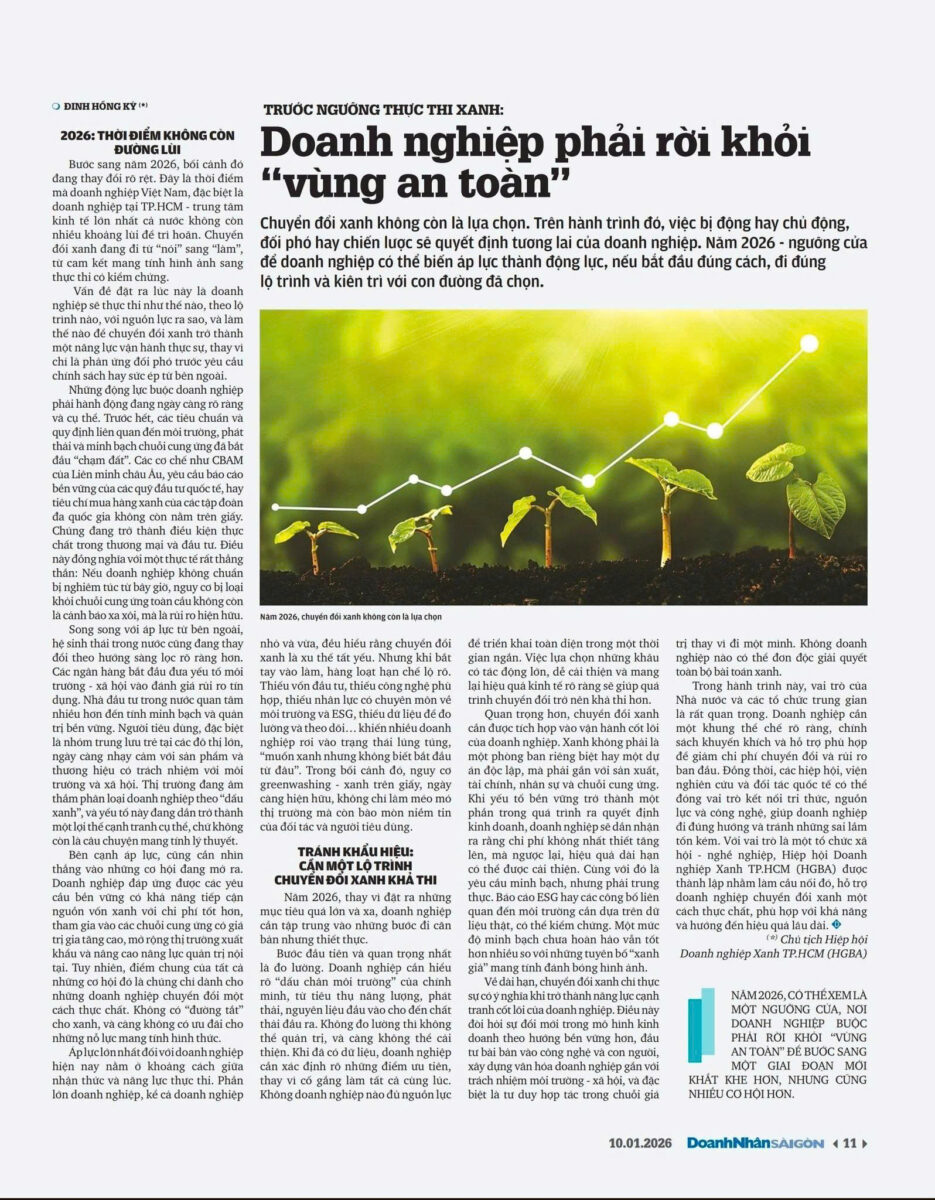
2026: A Point of No Return
As 2026 approaches, the context is changing markedly. This is the moment when Vietnamese businesses—especially those in Ho Chi Minh City, the country’s largest economic hub—have very little room left to delay. Green transition is moving from talk to action, from symbolic commitments to verifiable implementation.
The key question now is how businesses will implement it: along which roadmap, with what resources, and how to turn green transition into a genuine operational capability rather than a reactive response to policy requirements or external pressure.
The drivers compelling action are becoming increasingly clear and concrete. First, environmental, emissions, and supply-chain transparency standards and regulations have begun to take effect. Mechanisms such as the EU’s CBAM, sustainability reporting requirements from international investment funds, and green procurement criteria from multinational corporations are no longer theoretical. They are becoming real conditions in trade and investment. This leads to a blunt reality: if businesses do not prepare seriously now, the risk of being excluded from global supply chains is no longer a distant warning—it is an immediate threat.

Alongside external pressure, the domestic ecosystem is also shifting toward clearer market screening. Banks are beginning to incorporate environmental and social factors into credit risk assessments. Domestic investors are paying greater attention to transparency and sustainable governance. Consumers—especially young, middle-class urban groups—are increasingly sensitive to products and brands that demonstrate environmental and social responsibility. The market is quietly classifying businesses by their “green signal,” which is steadily becoming a tangible competitive advantage rather than a theoretical concept.
Beyond pressure, opportunities are also emerging. Businesses that meet sustainability requirements can access green capital at better costs, join higher value-added supply chains, expand export markets, and strengthen internal governance capabilities. However, all these opportunities share one common condition: they are reserved for businesses that undertake substantive transformation. There are no shortcuts to green—and certainly no rewards for superficial efforts.
Moving Beyond Slogans: Toward a Feasible Green Transition Roadmap
The greatest challenge businesses face today lies in the gap between awareness and execution capacity. Most enterprises—including SMEs—recognize that green transition is inevitable. Yet when implementation begins, numerous constraints surface: lack of investment capital, inadequate technology, shortages of ESG and environmental expertise, and insufficient data for measurement and tracking. As a result, many businesses find themselves confused—wanting to go green but not knowing where to start. In this context, the risk of greenwashing—being green on paper only—is increasingly present, distorting the market and eroding trust among partners and consumers.
In 2026, rather than setting overly ambitious and distant goals, businesses should focus on fundamental but practical steps.
The first and most critical step is measurement. Companies need to understand their own environmental footprint—from energy consumption and emissions to input materials and output waste. What cannot be measured cannot be managed, let alone improved. With data in hand, businesses must identify priorities instead of trying to do everything at once. No enterprise has sufficient resources to implement a comprehensive transformation in a short period. Selecting areas with significant impact, relative ease of improvement, and clear economic benefits will make the transition more feasible.
More importantly, green transition must be integrated into core operations. Sustainability should not be confined to a separate department or treated as a standalone project; it must be embedded in production, finance, human resources, and supply chains. When sustainability becomes part of business decision-making, companies often realize that costs do not necessarily increase—long-term efficiency can actually improve. Alongside this comes the requirement for transparency—but honesty is essential. ESG reports and environmental disclosures must be based on real, verifiable data. Imperfect transparency is far better than “fake green” claims aimed at image polishing.
In the long run, green transition only becomes meaningful when it evolves into a core competitive capability. This requires innovation in business models toward sustainability, systematic investment in technology and people, the cultivation of a corporate culture rooted in environmental and social responsibility, and—crucially—a collaborative mindset across the value chain rather than going it alone. No business can solve the green challenge in isolation.
In this journey, the role of the State and intermediary organizations is vital. Businesses need a clear institutional framework and appropriate incentive and support policies to reduce transition costs and early-stage risks. At the same time, associations, research institutes, and international partners can act as connectors—linking knowledge, resources, and technology—helping enterprises move in the right direction and avoid costly mistakes. As a socio-professional organization, the Ho Chi Minh City Green Business Association (HGBA) was established to serve precisely this bridging role, supporting businesses in pursuing a substantive, capability-aligned, and long-term effective green transition.
* Chairman of the Ho Chi Minh City Green Business Association (HGBA)