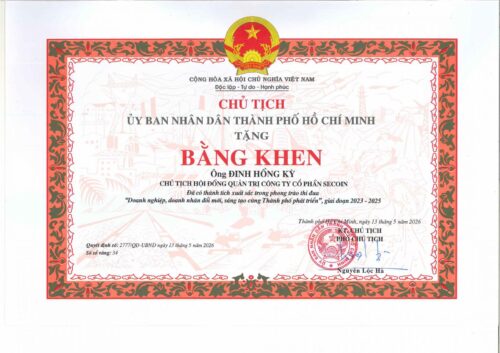
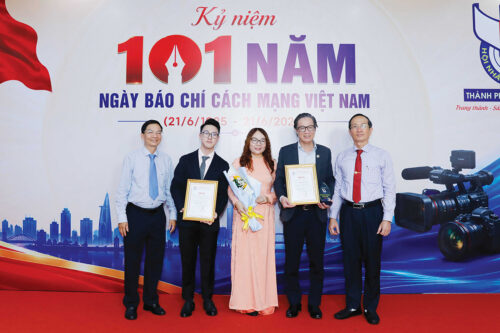
When non-fired bricks were an entirely new concept in Vietnam in the 1990s, engineer Dinh Hong Ky decided to seize the opportunity to become a pioneer. Growing up in a family with a scientific background, Dinh Hong Ky had a passion for research from a young age. After graduating from Hanoi University of Science and Technology, he worked for a state-owned company and also participated in managing Secoin, a business founded by his father, Professor Dinh Xuan Ba.

A Successful Career for the Engineer from Bach Khoa
In 1990, Hong Ky went to Poland to serve as the representative of the Vietnam Trade Office there, handling major foreign trade contracts for the state. At the same time, he took advantage of opportunities to bring computers from Poland to Russia for sale, exchanged goods for electrical cables in Russia to bring back to Vietnam, and conducted debt repayment trade between Vietnam and Eastern European countries.
“In addition, I gathered textile products in Vietnam to export to Poland, Czechoslovakia, and Hungary,” he recounted.
In 1995, Hong Ky returned to Vietnam to become the director of Secoin, while Professor Dinh Xuan Ba served as chairman of the company. At that time, the economy was starting to open up, creating a strong demand for technology and technical expertise. The company focused on international technology transfer activities to Vietnam.
Hong Ky’s experience in technology transfer showed that non-fired brick technology was developing worldwide, yet most construction bricks in Vietnam were still fired bricks.
In 1996, Hong Ky opened a non-fired brick production workshop in Hanoi. His parents opposed the move because they wanted the company to focus on services. Moreover, they believed that production was the first stage in the service chain and thus had relatively low profit margins.
Confident in the prospects of non-fired bricks and eager to seize the opportunity while others remained hesitant, as well as wanting to create a core product for Secoin that brought higher value to society, Hong Ky was determined to carry out his plan.
Mastering the technology, producing diverse and pioneering types of bricks, and building a strong team, within less than a year Secoin supplied non-fired bricks to many major projects in northern Vietnam and even exported products abroad.
Challenges in Conquering the Southern Market
With the support of his parents, and the companionship of his sister and wife, Hong Ky turned Secoin into a leading building materials brand, receiving numerous prestigious awards. In 2002, the company decided to conquer the southern market.
“If we succeed in conquering the southern market, Secoin will rise to a new stature,” Hong Ky assessed.
However, the journey to penetrate the southern market did not meet expectations. For many years, Secoin’s product sales in the south were slow, and the brand could not spread widely there. He spent a great deal of time traveling to the south and supporting his associates, but results remained unfavorable.
Facing this dilemma, Hong Ky realized that his mistake was applying northern mindset in producing, marketing, and selling products to southerners without truly understanding their psychology and needs.
The only solution was for Hong Ky to move to the south and become part of life there. Only when he genuinely thought and felt like a southerner could he sell products to them.
But by then, Hong Ky was nearly 45 years old, business operations in the north were still very successful, and all his close relatives were in Hanoi. Moving to the south meant a harder life and losing close supervision of northern market operations. The businessman in his forties faced a very difficult choice.
Source: Báo Diễn đàn Doanh nghiệp, Ngày 10/02/2020